
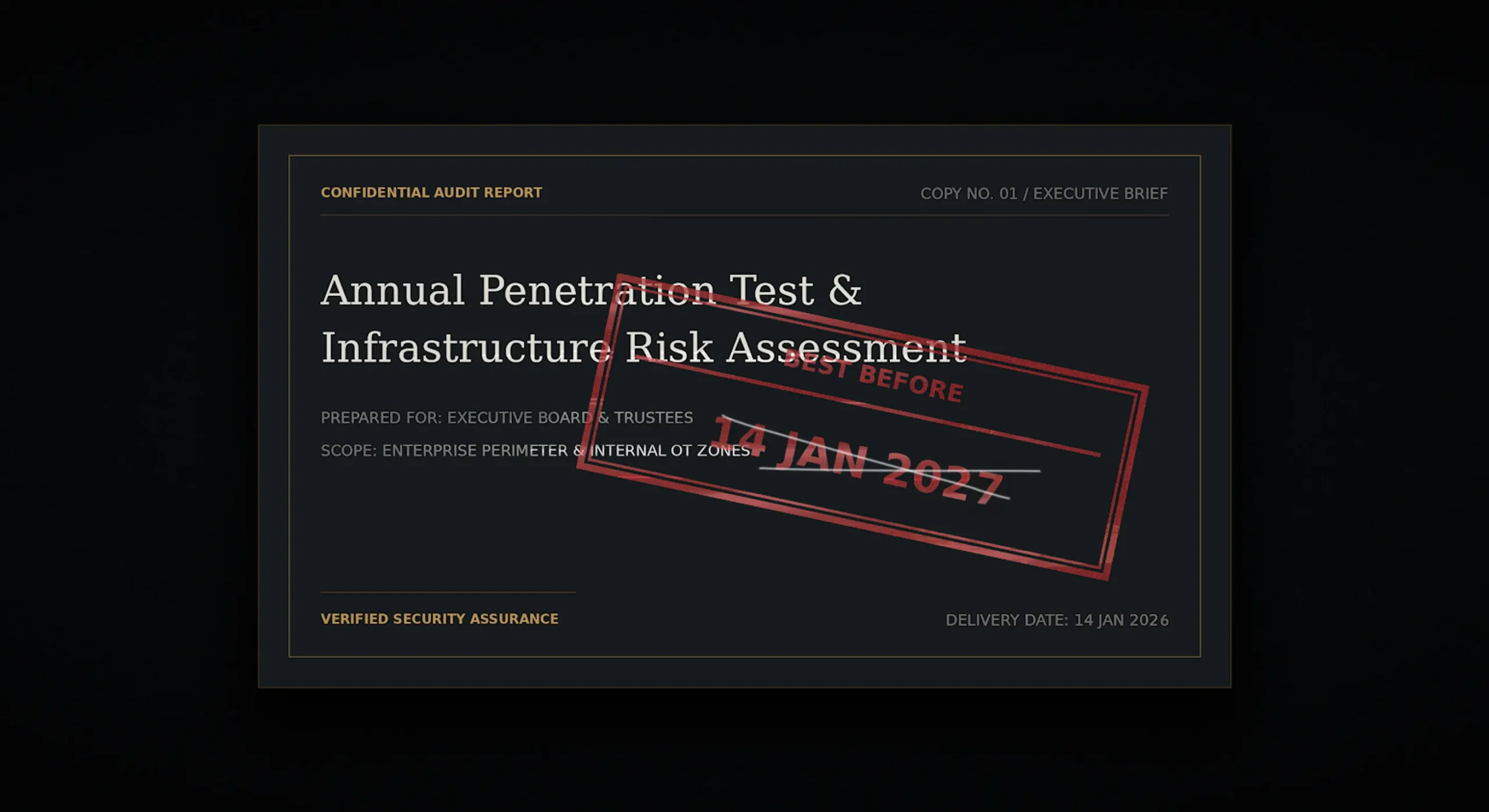
Your recent pentest has already expired. Why a clean audit report is the most dangerous document on your desk.
An annual security review arrives with the quiet authority of a clean bill of health. It is detailed, accredited, and bound in a pristine PDF. It is also quietly, irrevocably decaying from the moment it is delivered.
Understanding your risk posture usually begins with two distinct tools. First, mapping what is visible on the outside through an External Attack Reconnaissance Review (EARR), a passive, outside-in assessment that identifies exposed assets without touching internal systems. Second, testing what breaks on the inside through a penetration test, where a certified tester manually exploits specific findings to prove whether a breach path actually exists.
Both reports are accurate on the day they are compiled. Both start going stale within days, sometimes hours, of being signed off. Active Directory changes. Cloud infrastructure shifts. Routine code deploys every week. Each minor configuration update creates an opportunity for a brand new attack path to open, completely invisible to whichever report was compiled last.
The collapsing timeline to exploitation
The fundamental flaw in annual testing is that it relies on an operational timeline that no longer exists in the real world.
In 2018, the mean time to exploit a newly discovered vulnerability was 63 days. Security teams had two full months to review reports, order patches, schedule maintenance windows, and deploy fixes before adversaries weaponised the flaw. By 2024, that window had already turned negative, with exploitation beginning before defenders had a chance to respond.
Today, according to industry intelligence from Mandiant M-Trends, the mean time to exploit stands at an estimated minus seven days. Threat actors now routinely exploit new software vulnerabilities before a patch even exists. Expecting a point-in-time annual audit to protect an enterprise against zero-day exploitation is like checking the lock on a door once a year and assuming the house remains secure for the next three hundred and sixty-four days.
In 2018, organisations had two months to patch a vulnerability. Today, attackers exploit new flaws before the patch is even written.
Three structural flaws in point-in-time testing
Infrastructure is never static. As Active Directory updates, network segments adjust, and third-party vendors connect remote maintenance tunnels, internal attack paths shift. A static penetration report cannot account for the changes made during next week's routine maintenance, yet leadership continues to operate under the assumption of safety provided by last month's clean audit.
Traditional annual engagements spend a substantial portion of their billable hours on repeat administrative setup, scope re-scoping, and initial network orientation. Every twelve months, you pay external consultants to learn your architecture from scratch before they can begin testing. Without retained environment context, effective testing time is drastically compressed.
Passive mapping surfaces theoretical exposure, listing endless potential entry points without context. Conversely, a point-in-time penetration test proves what is exploitable on a single afternoon. Without pairing continuous external mapping with a recurring exploitation cycle, security teams spend endless hours chasing theoretical noise while genuine, newly opened attack routes go completely unnoticed.
The strategic shift: Continuous Threat Exposure Management
Closing this exposure gap requires moving away from discrete, episodic audits toward Continuous Threat Exposure Management (CTEM). CTEM pairs continuous external attack surface reconnaissance with a recurring, scheduled penetration testing cycle on a single, unified clock.
Externally, passive reconnaissance runs continuously across your entire perimeter. The moment a new sub-domain goes live, a cloud tenant misconfigures, or corporate credentials leak onto the dark web, the system flags it immediately.
Internally and externally, recurring manual penetration testing replaces the annual review. Certified testers actively attack newly exposed vectors start to finish, proving exactly which vulnerabilities represent genuine paths into critical assets. Furthermore, because a dedicated lead consultant maintains retained context of your environment, every billable hour goes directly toward active validation rather than repeat setup.
Attacks do not take a break. Neither should your testing.
Three questions worth asking now
You do not need a complete architectural audit to establish whether your organisation is suffering from report decay. Three questions will locate the gap.
- How many Active Directory updates, cloud reconfigurations, or code releases have taken place across your network since your last penetration test?
- Does your team pay external security consultants to re-learn your network architecture from scratch every twelve months?
- How quickly would you know if a routine IT update inadvertently exposed an internal lateral movement path to the outside world?
If any answer is uncertain, that uncertainty is the finding. A security boundary that is only checked once a year is an unmonitored boundary for three hundred and sixty-four days.
At CyberPlus, we work with organisations, family offices, and maritime operations that require real-time validation of their risk posture rather than point-in-time reassurance.
Our Continuous Threat Exposure Management (CTEM) programme combines continuous external reconnaissance with a retained penetration testing cadence mapped to MITRE ATT&CK and NIST SP 800-115 standards.
If you would like to talk, you know where we are.
A point-in-time security review is a static snapshot. Continuous exposure management is a live stream.